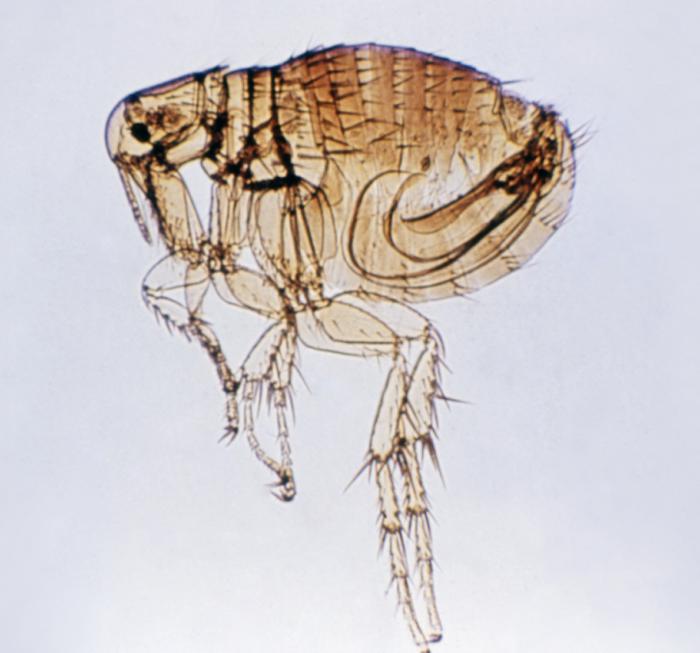
From - http://outbreaknewstoday.com/albuquerque-stray-cat-dies-plague-28389/
Albuquerque: Stray cat dies from plague
April 11, 2017
The City of Albuquerque Environmental Health Department, the
New Mexico Department of Health and the Bernalillo County Health
Protection Section announced today that a stray cat found in North
Albuquerque Acres was confirmed to have died of plague. A recent case
of plague in a dog in the same vicinity could indicate re-emergence of
plague in a part of the city where it was no longer thought to be found.
Image/CDC“Our ongoing surveillance has not detected plague in North Albuquerque Acres since the late 1990s,” said Dr. Mark DiMenna, Deputy Director at the City’s Environmental Health Department. “We
are asking residents in the area to report any pets, wildlife or feral
cats that appear to be sick or to have died without obvious physical
trauma to 311.”
Cats are particularly susceptible to plague, and plague can readily
be spread among cats in feral colonies. Health authorities advise those
working with free-roaming cats to be aware of symptoms of plague in
both humans and cats, and to report sick cats that may be displaying
those symptoms.
Symptoms of plague in cats can include swollen lymph nodes, vomiting,
diarrhea, loss of appetite, as well as presence of abscesses, discharge
or bloody sputum.
Most people contract plague from the bite of an infected flea, or
through direct contact with bodily fluids from an infected animal.
Symptoms in humans typically appear 1-8 days after exposure, and may
begin with painful, swollen lymph nodes or sudden fever and can progress
to severe headaches, muscle pain, nausea, vomiting, diarrhea,
eventually leading to shock and internal bleeding. Left untreated, or
if not diagnosed promptly, plague can be fatal in humans.
Plague is a bacterial infection. The causative agent is common in
many parts of New Mexico, including the Sandia Foothills and eastern
Bernalillo County.
Just
got a lovely update already from our pretty silver mac girl we placed
this weekend - at the Las Vegas show - but surprisingly to an AZ family
who had driven up to the show ! You just never know how life will work
out sometimes !
Message
: Hi Alice, I meet you yesterday and bought the female Siberian kitten
at the cat show in Las Vegas. she is just awesome and so well
socialized. We just lover her.
Just wanted to share this wonderful photo from Debbie's home,. She has 4 of our Kender Siberians - we are so blessed to have her as a kitty family of ours. Such great people.
Kisa
at the bottom, the oldest is 14 1/2!! Jaden, on the left is almost 13!
Milla, the red girl is 6, and Elsa, the girl in the top of the photo
is 4. Jaden aka, Kender's One Heart One Goal is great-grandmother to
Elsa aka Kender's Frozen Heart
This article is shared so you can have a heads up - a bit of knowledge that what you do MATTERS. how you conduct yourself and what you are bringing into the home - can make your best friend SICK or worse.
For good reason, there is a great deal of interest in the
transmission of diseases from animals to humans. Recently, however,
medical researchers have started to ask the opposite question: can we
make animals sick?
Swine and bird flu are two of the most recent and startling examples of animals passing diseases to humans.
Other unpleasant pet-to-human medical problems include ringworm, roundworm, and hookworm, as well as beaver fever, toxoplasmosis, and rabies.
Although these animal-to-human transmissions are relatively well
described, pathogenic traffic in the opposite direction is much less
well understood.
In this Spotlight feature, we will investigate whether pathogens can
travel from humans to animals in a process referred to as reverse
zoonosis, or anthroponosis.
A review of current literature on this topic, published in PLOS One
in 2014, identified a wealth of examples. They found cases of bacteria,
viruses, parasites, and fungi jumping from human hosts to animal-kind
to occur across 56 countries on every continent with the exception of Antarctica.
The importance of reverse zoonoses
Reverse zoonosis is not just an interesting concept; it is an important
global issue. Animals bred for food are transported far and wide,
interacting with wild species that they would never naturally have
encountered. With a rapid growth in animal production and an increase in
the movement of both animals and people, a human pathogen within an
animal could potentially move thousands of miles in just 24 hours.
On top of the increasing animal trade, we have an ever-growing pet industry. An estimated 68 percent
of people in the United States owned a pet in 2015 and 2016, up from 56
percent in 1988. Humans, animals, and disease are more entwined than
ever.
Understanding how diseases work across all scenarios is
essential for the future success of the human food chain and our
survival as a species.
Although guidelines, protocols, and legislation attempt to keep on top
of the increased movement of animals across the planet, the size of the
issue is immense. Above and beyond legal farms and markets, zoos and
aquariums, there is also an illegal meat trade that has the potential to
affect the situation significantly. For instance, some estimate that 5 tons of illegal bushmeat move through Paris' Roissy-Charles de Gaulle airport every week in personal luggage.
Early research into human to animal pathogens
The fact that diseases can pass from humans to animals is, perhaps, not such a surprise. An estimated 61.6 percent
of human pathogens are regarded as multiple species pathogens and are
able to infect a range of animals. Also, over 77 percent of pathogens
that infect livestock are multiple species pathogens.
Although investigating these interactions is not a new endeavor,
interest in the field has grown and developed over recent years. One of
the earliest studies demonstrating reverse zoonosis was conducted in
1988 and looked at dermatophytes - fungi that cause superficial infections of the skin, nails, and hair - including Microsporum and Trichophyton.
The authors found that these fungi could be transmitted from animal to
animal, human to human, animal to human, and human to animal.
In the mid-1990s, focus moved from fungal reverse zoonoses to bacteria, such as methicillin-resistant Staphylococcus aureus (MRSA) and Mycobacterium tuberculosis.
In the late 1990s, interest in viruses picked up, peaking during the 2009 H1N1
swine flu pandemic. From 2000, studies began to emerge investigating
the ability of certain parasites to pass from human to animal, including
Giardia duodenalis (the parasite responsible of giardiasis) and Cryptosporidium parvum (a microscopic parasite that causes the diarrheal disease cryptosporidiosis).
Below, we outline a selection of pathogens that have been observed jumping the gap between human and animal.
MRSA transferred from humans to their pets
MRSA is sometimes called a "superbug" because of its resilience to antibiotics. Infections caused by MRSA are notoriously difficult to treat and have the potential to be fatal.
Although cases of MRSA in the U.S. appear to be declining, it is still a significant public health concern.
A study, published in the journal Veterinary Microbiology in 2006, looked at MRSA in pets and its transmission between humans and animals. They concluded that:
The paper mentions a specific case in which a couple was repeatedly
infected with MRSA. The re-infections only stopped once their dog was
identified as the source and treated. It is presumed that the dog was
initially infected by the couple and then passed the infection back to
them each time they had been successfully treated.
With the inherent difficulties of treating MRSA, it is a genuine concern
if animals - and particularly pets - are able to contract and transmit
the pathogen. As the authors write: "The emergence of MRSA in household
pets is of concern in terms of animal health, and perhaps more
importantly, the potential for animals to act as sources of infection or
colonization of human contacts."
Tuberculosis in a Yorkshire terrier
A paper, published in 2004, describes the case of a 3-year-old Yorkshire
terrier who arrived at the University of Tennessee College of
Veterinary Medicine with anorexia, vomiting, and a persistent cough.
After running a barrage of tests - including, sadly, an eventual postmortem - the authors concluded that it had contracted tuberculosis (TB) (Mycobacterium tuberculosis).
The dog's owner had been receiving treatment for TB for 6 months. This
was the first documented transmission of TB from human to canine.
Cats are also susceptible to TB, but they most commonly catch cattle TB (M. bovis) or, more rarely, a version of the disease carried by birds (M. avium).
Dogs are not the only animals that can be affected by humanborne TB.
There have been a number of documented cases of elephants contracting TB
from humans, including three from an exotic animal farm in Illinois.
Cats catching flu from humans
In 2009, the first recorded case of fatal human-to-cat transmission of the H1N1 flu
virus occurred in Oregon. The owner of the cat had a severe case of
influenza and had to be taken to the hospital. Her cat - an indoor cat
with no exposure to other people or animals - later died of pneumonia caused by an H1N1 infection. Details of the case were published in the journal Veterinary Pathology.
In 2011 and 2012, researchers identified more than 13 cats and one dog
with pandemic H1N1 infection that appeared to have come from human
contact. Interestingly, the animals' symptoms were similar to those
experienced by human carriers - rapidly developing respiratory disease, a
lack of appetite and, in some cases, death.
Fatal respiratory illnesses in chimpanzees
Of all the animals, gorillas and chimpanzees are perhaps most
susceptible to human ailments, thanks to their similar genetic and
physiological makeup. They are known to be vulnerable to a number of
human diseases, including measles, pneumonia, influenza, a range of viruses, bacteria, and parasites.
Due to poaching, habitat loss, wildlife parks, zoos, and bushmeat
hunting, humans more frequently come into close proximity with primates.
Because of this, cross-species transmission of diseases is becoming a
pressing concern.
In 2003, 2005, and 2006, outbreaks of fatal respiratory disease struck
the wild chimpanzees at the Mahale Mountains National Park in Tanzania.
Although measles and influenza were both considered, no evidence to
support them as the cause could be found.
Researchers analyzed stool samples from affected and nonaffected
individuals, and they identified that a human-related metapneumovirus - a
virus that causes an upper respiratory infection - was to blame.
This dwindling population of chimpanzees was being decimated by a cold transferred to them by humans.
Similarly, in 2009, an outbreak of human metapneumovirus infection in
Chicago, IL, spread from infected zookeepers to a group of captive
chimpanzees. All seven became ill, and one died as a result.
African painted dogs
African painted dogs are an endangered species of wild dog. As part of the conservation effort, a study published in 2010 investigated the parasites present in the species' feces.
Infection by Giardia duodenalis, a parasite that lives in the small intestine, was found in 26 percent of wild animals and 62 percent of captive animals.
Although common in domestic cats and dogs, G. duodenalis is not
a parasite naturally found in African painted dogs. Additionally, the
strains of parasite found in the dogs' feces were of a subtype commonly
associated with humans, rather than the subtypes usually seen in pet
dogs.
Symptoms of the disease can include diarrhea, nausea, abdominal discomfort, and reduced appetite.
The authors concluded that the parasites had entered the population from
human-dog interactions and, from then on, were passed from dog to dog,
becoming a new potential threat to their already uncertain future.
Although research into reverse zoonosis is relatively scant, it is an
important and urgent field of study. If human pathogens are able to
infect other species, and these species are able to interact with humans
and travel great distances, it is a pandemic waiting in the wings.
We already know that the flu virus can mutate quickly, and by living in
different species, it has the chance to change and mutate in ways that
it could not in humans. As these pathogens change, they might become
less dangerous to humans. On the other side of the coin, however, some
might become increasingly deadly.
We have some good news
.Attended the local HCM screening clinic today
and the 2 girls we took are both HCM clear/negative.
Its the first
screen for both but always a good start!
Ashildr ( CFA Ch Kender's Lady
Sherade )
and Diamond ( CFA Ch Kender;s A Girls Best Friend ) are
officially HCM clear at this time. As they are basically babies ( 9
months and 1 yr) - we will continue to screen them again, later .